
The Reset Paradox: Net Zero Targets Were Always a Policy Bet
The 2026 reset is being read as a retreat. It is better understood as a re-underwriting, the moment the industry is forced to separate the pledge from the portfolio, and to admit what a lot of those 2020 pledges were actually betting on.
There is a tidy version of the 2026 net-zero story, and it goes like this: the alliances are buckling, US managers are fleeing antitrust threats, the 2050 language is being quietly deleted, and the whole edifice of climate finance is in retreat. The Net Zero Asset Managers initiative (NZAM) relaunched in February having dropped the requirement for members to set 2030 targets or commit to net zero by 2050, and the relaunch laid bare an exodus of US firms that split the industry along geographic lines. Retreat, in other words. Story filed.
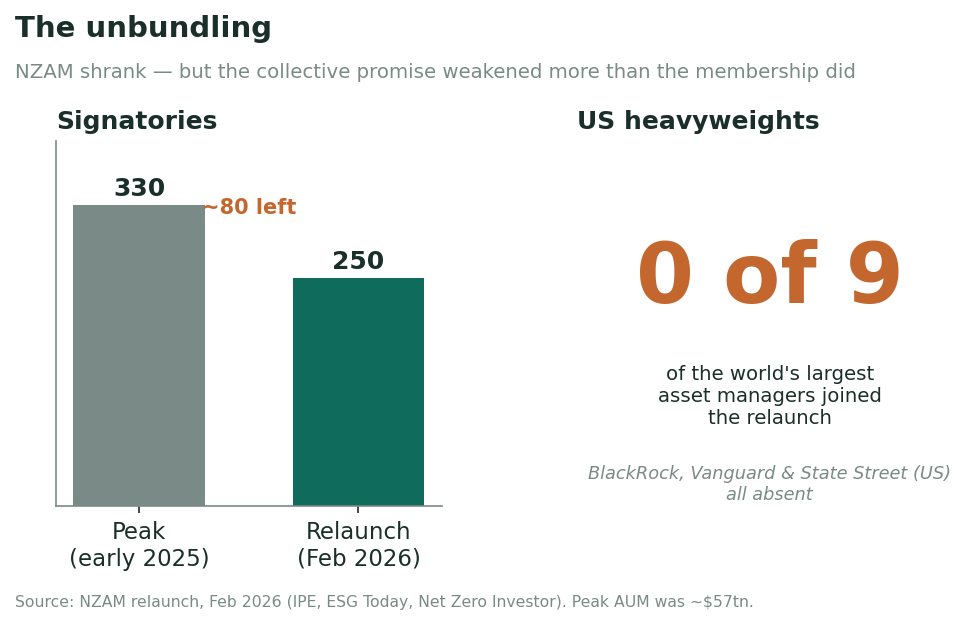
The numbers seem to back the retreat reading. NZAM peaked at roughly 330 signatories representing some $57 trillion in assets; it returned in February 2026 with about 250, after around 80 firms, Artemis, Capital Group, HSBC and Invesco among them, declined to re-sign. None of the world's nine largest asset managers are in the relaunched initiative; BlackRock, Vanguard and State Street's US arm all sat it out.
But the tidy version is shallow. It treats the target as the thing that matters and its loosening as the news. The more useful question is the one the reset forces into the open: what were these targets ever a commitment to? And the uncomfortable answer, visible in the fine print of the commitments themselves, and stated plainly by the people who set them, is that a large share of net-zero targets set in 2020 and 2021 were not commitments to act. They were bets on policy. The reset is the moment those bets come up for renewal.
What the targets were really underwriting
Start with the document that anchored the whole movement. NZAM's own commitment has always made the conditional explicit: the scope for asset managers to invest in line with net zero "depends on the mandates agreed with clients, and on the enabling environment, in particular the policies and regulations adopted by governments." Read that again. The pledge was never we will decarbonise these portfolios. It was we will decarbonise these portfolios if governments build the world in which doing so is consistent with our fiduciary duty. The carbon price, the phase-out schedules, the subsidy regimes, those were assumed as inputs, not committed to as outputs the manager could control.
That was not a secret, but it was easy to miss under the headline numbers. It becomes impossible to miss when you listen to the people who built the models. Robeco's climate strategist has described net-zero investors as "front-running behind the policy proposition", putting capital to work on the expectation that public policy would arrive to drive the transition, only to find the policy stalling and the investor exposed ahead of it.
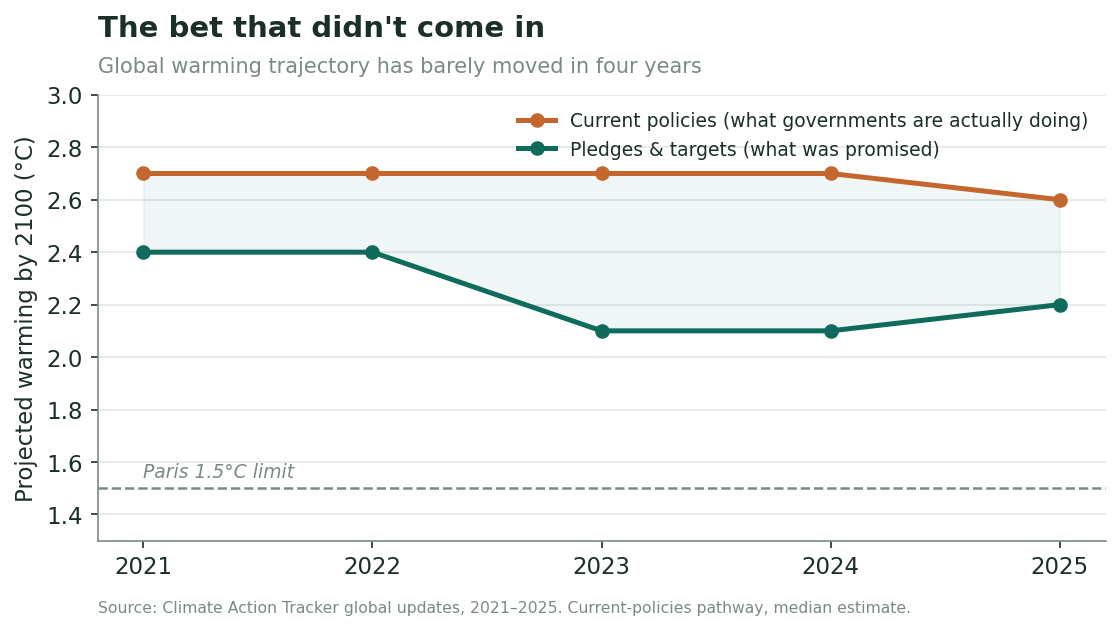
And the policy did stall. This is the part the retreat narrative never connects. According to the Climate Action Tracker, the world's warming trajectory has barely moved for four straight years: current government policies still point to roughly 2.6°C of warming by 2100, essentially flat since 2021. Even the more generous "pledges and targets" pathway has drifted in the wrong direction, from about 2.1°C to 2.2°C, partly because of the US withdrawal from the Paris Agreement invalidating its targets. The 2035 national commitments submitted ahead of COP30 made, in the Tracker's assessment, almost no difference. The enabling environment that the 2020 targets were underwriting simply did not show up.
The academic record on how those targets were set is even more blunt. In one set of structured interviews with asset managers, eight separate respondents said their net-zero target had been set on the assumption that the world would simply decarbonise around them. One described, in as many words, "a tension between ambition and credibility." Others admitted that in the rush to announce a net-zero ambition, the potential conflict between that target and their fiduciary duty was never fully worked through, building in, from the start, the possibility of backtracking the moment financial reality and the pledge stopped pointing the same way.
This is the crux. A target premised on "the world will decarbonise and we will be well-positioned when it does" is not a plan. It is a forecast wearing a plan's clothes. And a forecast that has been falsified by events, flat for four years, and counting, does not deserve to be defended; it deserves to be re-underwritten.
Why the reset is clarifying, not cowardly
If you accept that framing, the 2026 reset stops looking like surrender and starts looking like an overdue audit.
Consider what actually changed. NZAM did not tell its members to stop decarbonising. It removed the shared 2050 destination and the mandatory interim targets, and shifted to a model where signatories independently set their own targets, choose their own strategies, and report annually. More than 250 managers still signed the revised statement, and the relaunch was backed by a group of over 50 asset owners representing more than $3.7 trillion. The collective promise weakened; the individual obligation to show your work did not. The new emphasis, in the initiative's own framing and its members', is on real-world impact balanced against practical implementation, which is precisely the language of people who have stopped forecasting and started accounting for what they can actually deliver.
The cost is real and worth naming. Membership of a net-zero alliance once functioned as a signal: it meant a firm had accepted a common baseline. Strip out the shared benchmarks and that signal degrades, participation now says less about what a firm is doing than about what it is willing to say. NZAM today is neither a stringent club nor an empty shell, but something ambiguously in between. For an industry that is, at bottom, a signalling business, that is a genuine loss.
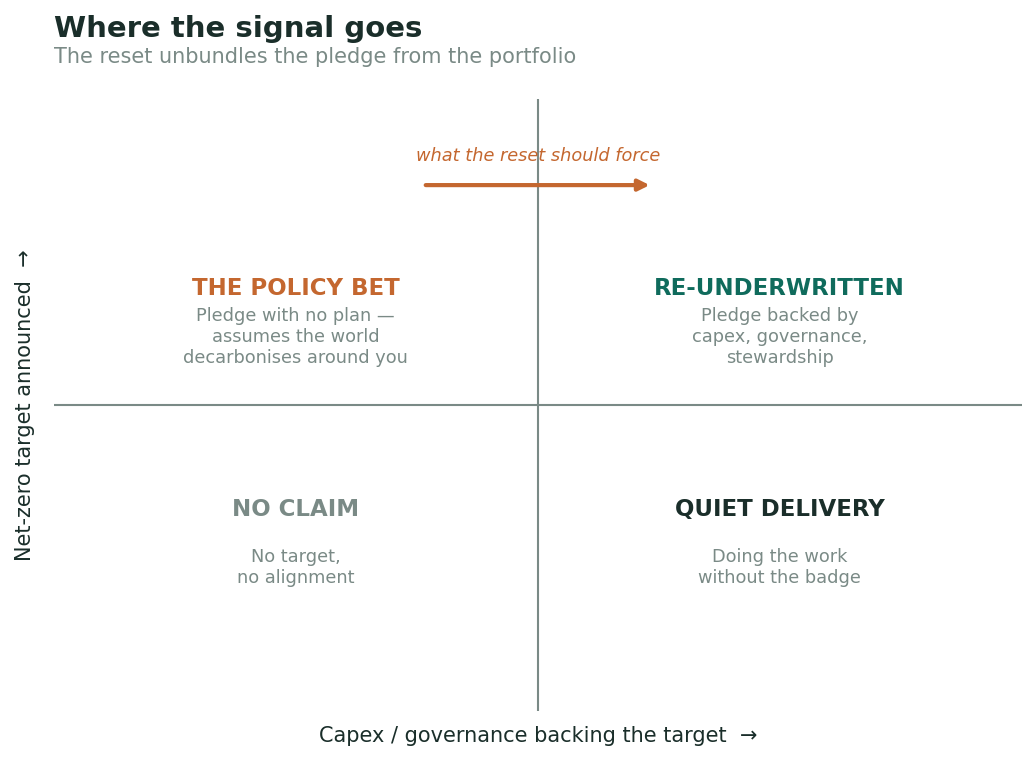
But it is a loss of a signal that was misleading. The old badge bundled two very different things, "this firm is decarbonising its portfolios" and "this firm is betting that policy will let it", and let the second masquerade as the first. The reset unbundles them. What remains is harder to read at a glance, which means the reading work moves to where it should have been all along: the mandate.
The work moves to the asset owner
Here is the part the retreat narrative misses entirely. When the coalition stops doing the signalling, somebody else has to. And the somebody is the asset owner.
The clearest articulation of this came, ironically, from a net-zero campaigner criticising the NZAM climbdown: the change is bad news for pension funds, who will now have to redouble their efforts to identify the managers who take fiduciary duty seriously by genuinely integrating climate risk, and who stay the course when political headwinds intensify. That is a complaint, but it is also a job description. The diligence that the alliance badge used to outsource now has to be insourced into manager selection and mandate design.
Some asset owners are already doing exactly this. European schemes, The People's Pension and PFZW among them, have been moving assets toward managers that can demonstrate credible climate alignment, rather than managers that merely belong to the right club. UK pool Border to Coast has explicitly said NZAM membership is no longer a deal-breaker for its external managers, provided they can show adherence to its broader responsible-investment standards. That is the signal migrating from coalition membership to capital allocation, which is a far harder signal to fake. A firm can sign a statement in an afternoon. It cannot fake a five-year track record of green capex alignment, transition-plan governance, and stewardship that survives a hostile political cycle.
And the tooling is catching up to support exactly that kind of judgement. Robeco's transition model, for instance, scores companies not on whether they have a target but on whether their capex spend reveals a surplus or a gap against it, translating ambition into something you can underwrite. That is what re-underwriting looks like in practice: not "do you have a 2050 goal" but "show me the capital expenditure that makes your pathway real."
The reset paradox
So here is the paradox. The weakening of the net-zero alliances looks like the financial sector losing its nerve on climate. In substance it is closer to the opposite: the removal of a comfortable collective fiction that let a policy forecast pass as a portfolio commitment. What survives the reset is narrower, less flattering, and more honest, a set of managers who have stopped promising a destination they cannot reach on their own, and started accounting for the distance they can actually cover.
The targets that were quietly assuming the world would decarbonise on their behalf are gone, or going. Good. They were never commitments; they were bets, and the bet, flat at 2.6°C for four years, has been called. The interesting question for 2026 is not who left the alliance. It is which managers, stripped of the badge, can still show an asset owner the capex, the governance, and the stewardship to prove they were doing the work all along, and which ones were only ever holding a ticket on a policy that never came in.
The five-year reviews now landing across the industry are usually described as a chance to raise or lower ambition. That is the wrong frame. They are a chance to re-underwrite an assumption. The managers who treat them that way will come out of the reset with something more durable than a pledge: a position they can actually defend.
This piece is independent research and commentary. It is not investment advice. Figures as of the NZAM relaunch (February 2026); warming projections from the Climate Action Tracker 2025 global update.