
Beyond Portfolio Decarbonization: Rethinking Climate Targets for Investors
Over the past decade, portfolio decarbonization has become a central objective for institutional investors. Net-zero commitments, financed-emissions targets, and carbon-intensity reductions are now widely used to measure progress.
But an important question is increasingly being asked: does reducing the carbon intensity of a portfolio actually reduce emissions in the real economy?
As climate investing evolves, many investors are beginning to reassess whether portfolio emissions alone are the right metric for measuring climate impact.
Why portfolio decarbonization became the default
Portfolio emissions metrics emerged because investors needed quantifiable ways to track climate progress. Frameworks such as the Net Zero Investment Framework and reporting standards from the Partnership for Carbon Accounting Financials made it possible to measure financed emissions across asset classes and set interim decarbonization targets.
Metrics such as carbon intensity, financed emissions, and portfolio temperature alignment provided investors with clear indicators of climate exposure. These metrics also helped align investment strategies with broader net-zero commitments made by governments and corporations.
As a result, portfolio decarbonization quickly became the most visible indicator of climate progress in the investment industry.
However, as climate strategies matured, investors began to recognize an important limitation: portfolio metrics measure financial exposure to emissions, not necessarily emissions themselves. Reducing exposure to high-emitting companies can lower the carbon footprint of a portfolio without directly reducing emissions in the real economy.
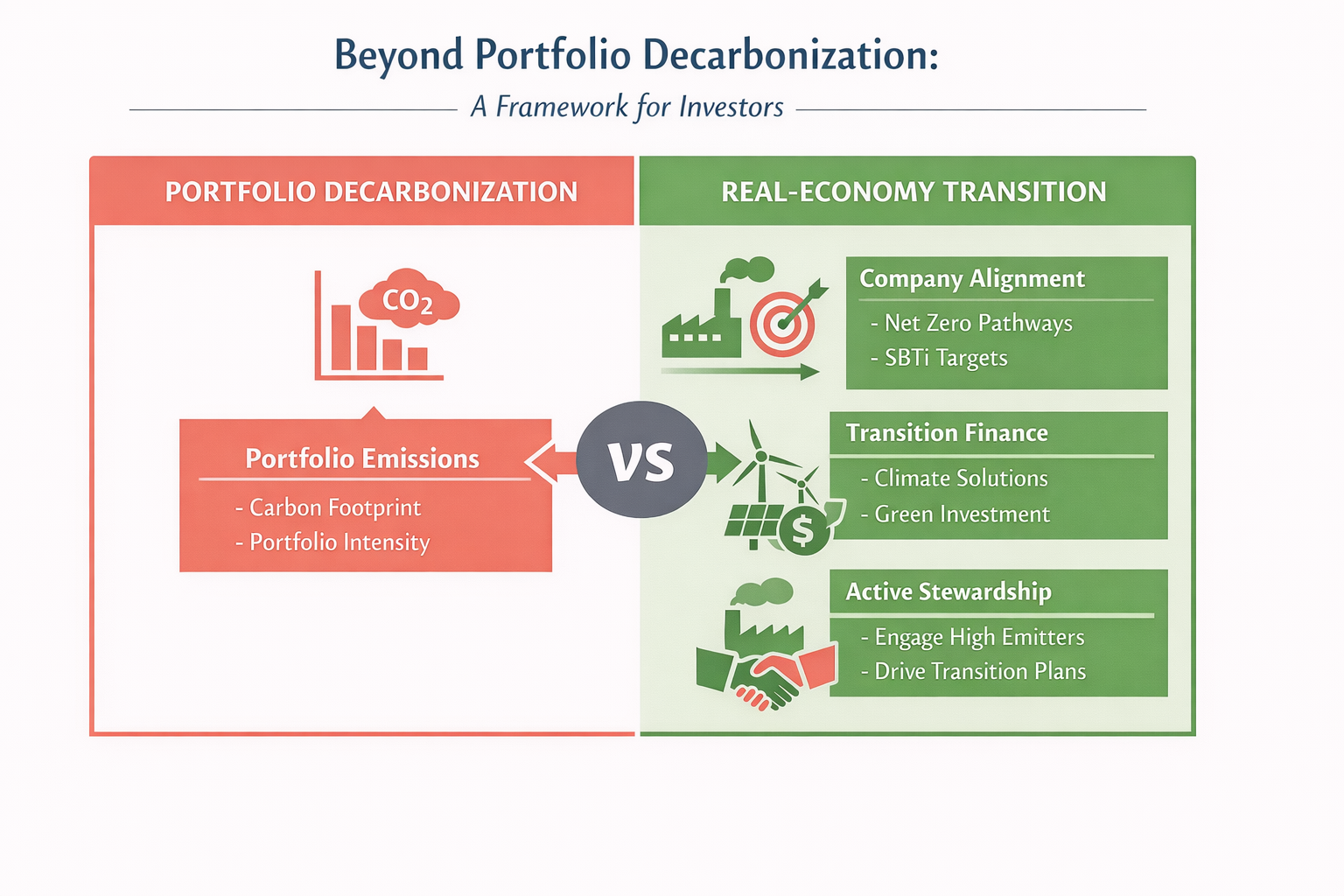
The critique: portfolio metrics vs real-world emissions
The main critique of portfolio decarbonization is straightforward: portfolio emissions can fall without global emissions declining. There are several ways this can happen.
Divestment without transition
If an investor sells shares in a high-emitting company, the portfolio's carbon footprint declines immediately. However, the company's emissions remain unchanged. Ownership simply transfers to another investor. This dynamic has led many investors to question whether divestment alone can deliver real-world decarbonization.
Ownership transfer
In some cases, carbon-intensive assets move from public markets into private ownership where climate disclosures are less transparent. When this happens, emissions may simply shift to parts of the financial system where they are harder to track.
Sector reallocation
Portfolio emissions can also decline through simple sector rotation. Investors may reduce exposure to energy or materials while increasing exposure to sectors such as technology or healthcare. While this improves the carbon profile of the portfolio, it does not necessarily change emissions in the real economy.
These dynamics have contributed to a broader debate within the investment community about whether portfolio emissions alone are an adequate proxy for climate impact.
From decarbonization to portfolio alignment
In response, many investors are shifting from a focus on portfolio decarbonization toward portfolio alignment with net-zero pathways.
The Institutional Investors Group on Climate Change has played a central role in this shift through the Net Zero Investment Framework. The framework emphasizes that the ultimate objective of climate investing should be real-economy decarbonization, not just lower portfolio emissions.
Rather than focusing only on reducing financed emissions, the framework encourages investors to assess whether portfolio companies are aligned with credible transition pathways. This involves evaluating factors such as:
- Science-based climate targets
- Credible transition plans
- Forward-looking emissions trajectories
- Capital expenditure aligned with decarbonization
In other words, the focus shifts from where emissions are today to whether companies are actually transitioning.
Examples of investors moving beyond portfolio decarbonization
Several asset managers and asset owners have begun incorporating alignment targets and engagement strategies alongside portfolio emissions metrics.
Comgest: alignment targets
The asset manager Comgest uses the Net Zero Investment Framework to assess whether portfolio companies are aligned with net-zero pathways. One of its climate targets is to increase the share of listed-equity assets invested in companies that are aligned or aligning with net zero.
This approach shifts the focus from simply lowering portfolio emissions to ensuring that companies themselves are moving toward credible transition pathways.
Brookfield Asset Management: investing in transition
Brookfield has argued that the energy transition requires investors to allocate capital to carbon-intensive sectors that need to decarbonize. Through dedicated transition funds, the firm acquires high-emitting assets and seeks to improve their emissions profile over time.
This strategy reflects the view that investors may need to engage directly with high-emitting assets in order to reduce emissions.
BlackRock: science-based targets
BlackRock's climate strategy includes increasing the share of companies in its portfolios that have science-based emissions targets or credible transition plans. Rather than focusing exclusively on portfolio emissions reductions, the firm has emphasized the importance of tracking whether companies are adopting measurable decarbonization pathways.
Universities Superannuation Scheme: stewardship over divestment
The UK pension fund Universities Superannuation Scheme has argued that active stewardship may be more effective than divestment in achieving real-world emissions reductions. Selling high-emitting assets may simply transfer ownership to investors with fewer climate commitments. Instead, the fund emphasizes engagement with companies to support credible transition strategies.
Alternative climate targets for investors
As investors rethink climate strategies, several complementary targets are emerging alongside portfolio decarbonization.
Asset alignment
Share of the portfolio invested in companies aligned with net-zero pathways.
Transition engagement
Coverage of engagement with the highest-emitting companies in the portfolio.
Climate solutions allocation
Capital allocated to activities that support the energy transition.
Forward-looking transition indicators
Metrics such as green capital expenditure, emissions trajectories, and science-based targets.
These indicators focus more directly on whether companies are transitioning, rather than simply measuring emissions at a single point in time.
Implications for investors
Portfolio decarbonization remains a useful tool. It provides a measurable indicator of climate exposure and allows investors to track progress toward net-zero commitments.
However, portfolio emissions alone cannot capture the full impact of investment decisions on the real economy. A more comprehensive climate strategy may therefore require a combination of targets:
- Portfolio emissions trajectory
- Alignment with net-zero pathways
- Engagement with high-emitting companies
- Capital allocation toward climate solutions
Together, these elements are more likely to contribute to actual reductions in global emissions.
Conclusion
Portfolio decarbonization has played an important role in bringing climate considerations into mainstream investment management. But as climate investing evolves, the limitations of portfolio emissions metrics are becoming clearer.
The next phase of climate investing may require moving beyond portfolio metrics alone.
The goal of climate investing is not simply to build low-carbon portfolios. The goal is to help finance the transition to a low-carbon economy.