
In a world shaped by rising geopolitical competition, rapid technological disruption and mounting societal pressures, the World Economic Forum's Global Risks Report 2026 paints a stark picture of what lies ahead. The report reflects the views of over 1,300 leaders and experts across government, business and civil society, revealing how risks shift when you look just a couple of years ahead versus the next decade.
Short-Term Outlook (Next 2 Years)
Over the next two years, immediate pressures on the global system are led by geopolitical and societal risks, as well as some environmental concerns that remain relevant:
- Geoeconomic Confrontation, #1 short-term risk: Economic competition between states and the weaponisation of trade and investment is ranked most likely to trigger disruption.
- Mis- and Disinformation: deepens social fragmentation.
- Societal Polarisation: societal divisions fuel instability.
- State-Based Armed Conflict: persistent geopolitical tensions.
- Environmental Risks:
- Extreme Weather Events: remain in the top five even in the short term.
- Pollution and other environmental threats also feature among risks experts watch, even if they rank lower than geopolitical challenges.
The take-away? In the immediate future, climate-related shocks will still strike unpredictably, but they're competing with sharp geopolitical fractures and societal challenges for attention and resources.
Long-Term Outlook (Next 10 Years)
When the horizon is extended to a decade, the environmental risks dominate, underscoring how slow-burn, systemic hazards are poised to become defining threats:
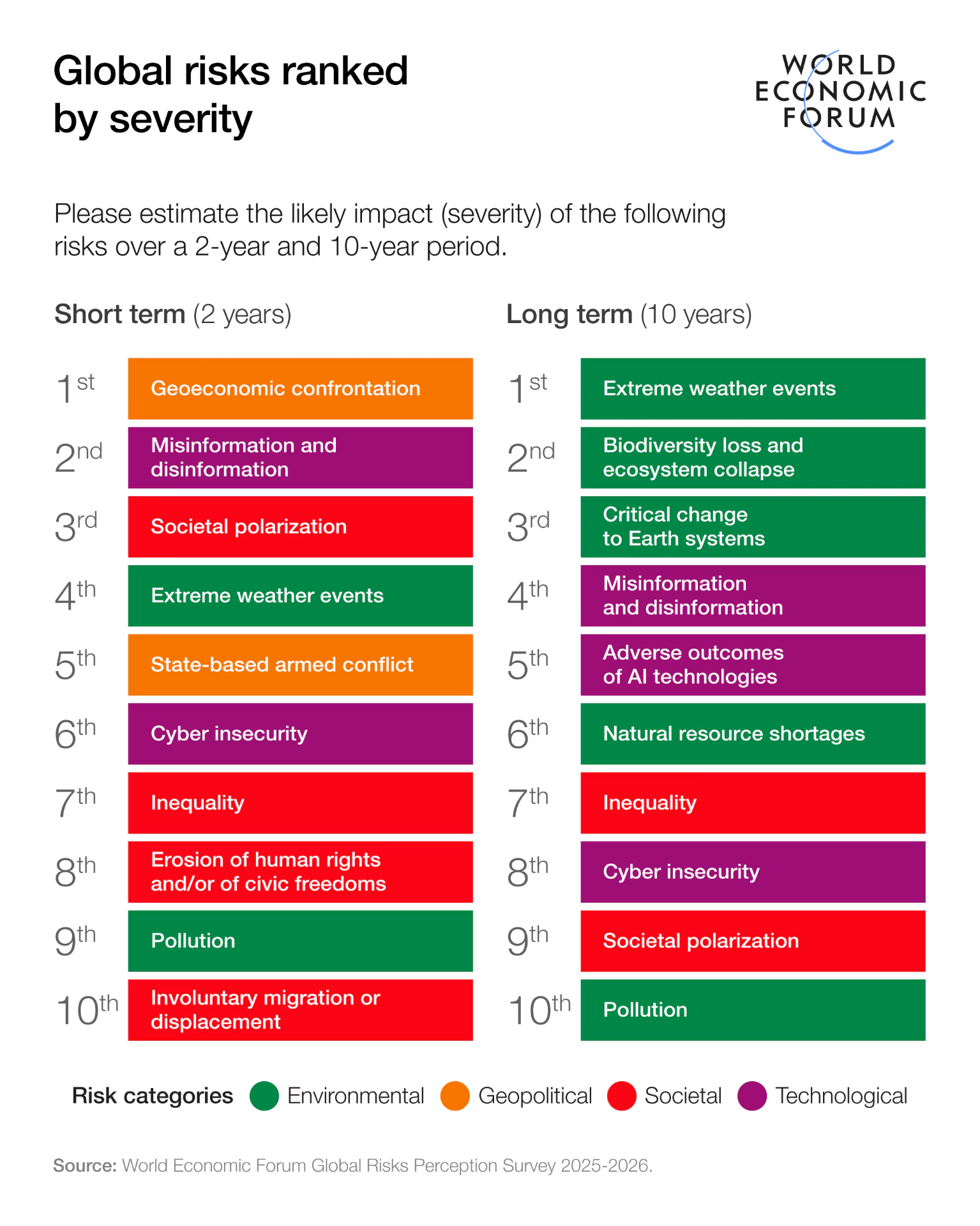
- Extreme Weather Events: consistently ranked the most severe long-term threat, driven by climate change.
- Biodiversity Loss and Ecosystem Collapse: the degradation of life-support systems for food, water and human health makes this a core global danger.
- Critical Change to Earth Systems: disruptions to climate, oceans and natural cycles risk cascading effects across economies.
- Natural Resource Shortages: shortages of water, arable land and minerals threaten development and stability.
- Pollution: from air to plastics to chemicals, pollution remains among the top long-term risks.
Even when non-environmental hazards like misinformation and adverse technology outcomes are considered, more than half of the most severe long-term risks are connected to nature and climate impacts.
Why the Environmental Focus Matters
While short-term headlines may be dominated by geopolitical competition and cyber disruption, environmental risks are slower, cumulative, and systemic:
- Climate-driven extreme weather disrupts food systems, infrastructure and economies worldwide.
- Biodiversity decline erodes natural resilience and weakens ecosystem services we all rely on.
- Resource depletion, especially water, is already triggering social stress and could redefine geopolitics itself. Recent reports even warn of a world in "water bankruptcy" due to overuse and climate impacts.
The long-term risk rankings remind us that environmental degradation is not distant or abstract: it is deeply tied to economic security, human health and global stability. These risks don't just persist, they intensify over time.
Conclusion
The WEF's Global Risks Report tells a compelling story:
- In the near term, the world grapples with geopolitical rivalry, societal division and technological disruption.
- Over the next decade, environmental risks eclipse nearly all others, with climate change, biodiversity loss, Earth system shifts and resource shortages at the top of the list.
For policymakers, businesses and communities alike, this dual-track risk landscape calls for urgent action now, and transformational change to build resilience for the long haul.