
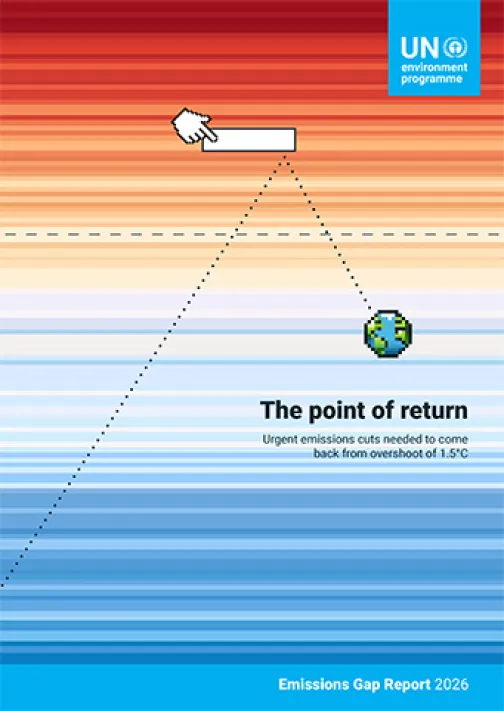
UNEP's Emissions Gap Report 2026, The point of return, changes the question the climate community has been asking for a decade. The report concludes that the chance of holding warming to 1.5°C with no or limited overshoot is gone, and what is left to decide is how high the overshoot goes and how long it lasts. For transition investors, that shift matters more than any single number in the report. The reference point most climate strategies were built on has been withdrawn. Ambition is now measured against a pathway that peaks near 1.8°C and returns to 1.5°C only by 2100 with about a 50% chance, while even the most optimistic pledge case on the table still lands at 2.1°C. That moves the question from whether overshoot happens to how deep the physical and policy shocks become on the way back.
A smaller gap, but a worse future
The gap is measured against the lowest 1.5°C overshoot still available, a pathway that assumes stringent mitigation starting in 2025, a 66% chance of limiting peak warming to 1.7-1.8°C, and a return to 1.5°C by 2100 with around a 50% chance.
Joeri Rogelj, a long-serving lead author of the series, put it as a smaller gap but a worse future. The smaller gap is partly an artefact of a changed benchmark. Against the old no-overshoot scenario, the report finds an unbridgeable 9 GtCO2e gap in 2035.
The remaining path is steep. Relative to 2025, emissions must fall 18% by 2030, 45% by 2035 and 69% by 2040, and net-zero CO2 arrives around 2050 (range 2046-2058). That averages 5.7% a year in cuts over 2025-2035, faster than the 5.0% the previous benchmark required. The pathway also relies on permanently removing roughly 320 GtCO2 over the century, and the report calls that uncertain given the obstacles to scaling removal. The benchmark has moved in two directions at once, since the pathway that replaces the old one is steeper and leans on removal at a scale the report itself is not yet able to underwrite.
Where we stand
Global emissions were 58.4 GtCO2e in 2025, 0.1 GtCO2e below 2024 (itself revised up to 58.5). With an uncertainty range of ±5.5, the report says it is too soon to call a plateau. Fossil CO2, N2O and F-gases all rose, and what offset them was a drop of about 0.5 GtCO2e in land-use emissions, partly from fewer wildfires than in 2024. The report treats that as a weather-dependent cushion rather than structural decarbonisation. The structural signal came from power: according to the report's analysis, 2025 was the first year renewables (33.8%) generated more electricity than coal (33.0%). So the evidence that decarbonisation has begun sits in one sector, while the gap that has to close sits in the others.
Policy ambition is improving, though not fast enough. 124 Parties, covering about three quarters of global emissions, have submitted new NDCs, up from 57 covering 63% last year, yet the report says the new NDCs have a near-zero effect on expected emissions and warming. Full implementation would cut emissions 5-8% by 2030 and 11-15% by 2035, against the 18% and 45% required.
| Scenario | Gap to lowest 1.5°C overshoot, 2030 | Gap, 2035 |
|---|---|---|
| Current policies | 9 GtCO2e | 22 GtCO2e |
| Unconditional NDCs | 7 GtCO2e | 19 GtCO2e |
| Conditional NDCs | 5 GtCO2e | 16 GtCO2e |
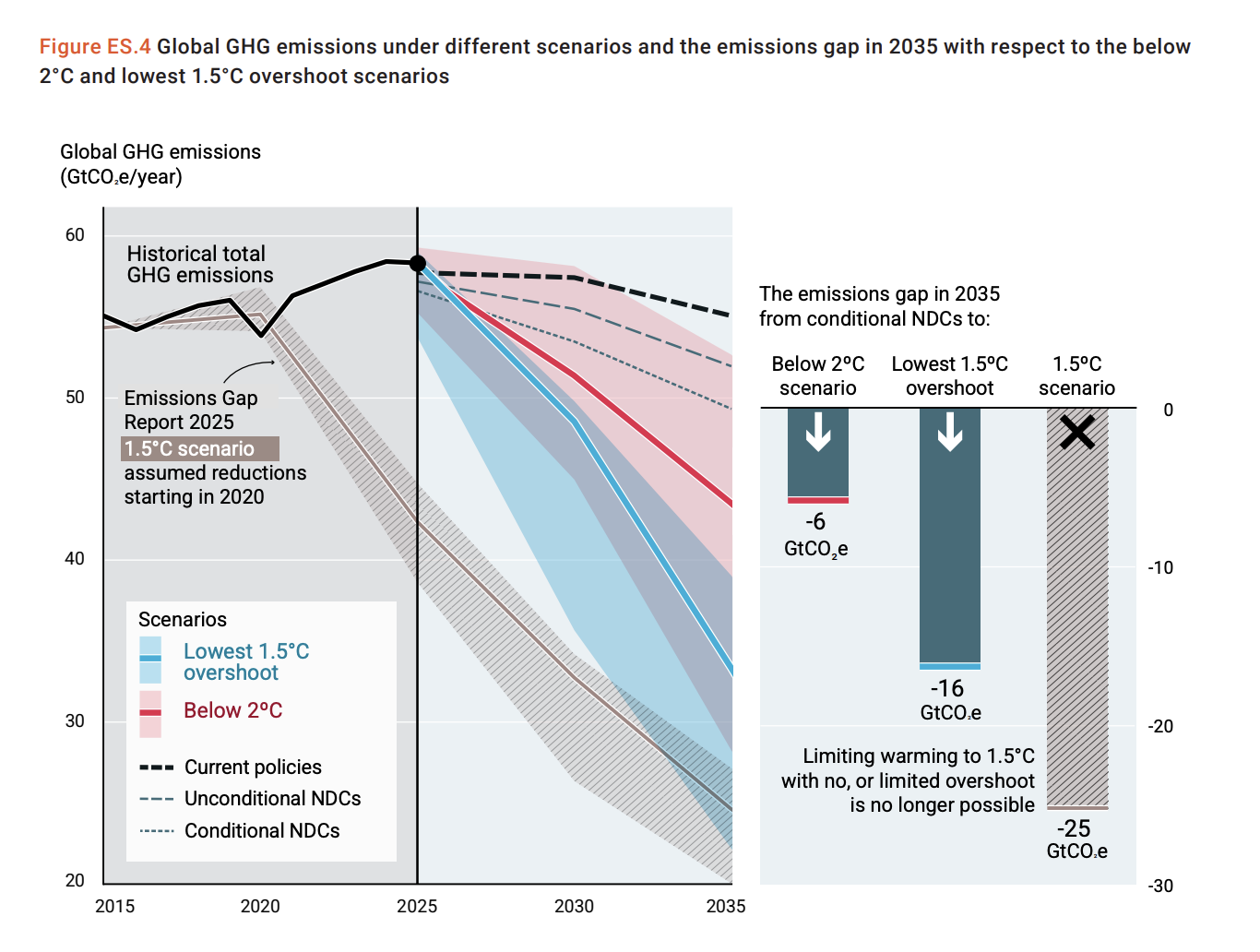
Projected warming by 2100 (66% chance) is 2.8°C under current policies, 2.6°C if all NDCs are delivered, and 2.1°C in the most optimistic pledge-based scenario, which assumes all net-zero targets are also met. The NDC and net-zero estimates are worse than last year's because the US withdrew from the Paris Agreement and historical emissions were revised up, and even the best pledge-based case implies about 0.25°C more peak warming than the lowest overshoot pathway. The arithmetic of delay is at least calculable: every five years of emissions at current levels adds around 200 GtCO2 and about 0.1°C of peak warming.
Those projections are the numbers a scenario set has to be tested against. A central case at or below 2.1°C assumes pledges the report says have had a near-zero effect on expected emissions so far, and it sits closer to the lowest overshoot pathway than to what current policies produce. The spread from 2.8°C to 2.1°C is too wide to average into a single planning number, and each end points at a different set of exposures.
Five takeaways for transition investors
These are my interpretations of what the findings imply for capital allocation, not conclusions drawn by the report.
1. Clean technology alone is not enough, and the report says so
Absolute emissions from energy, road transport and methane are still moving in the wrong direction relative to the first global stocktake's goals. Coal is set to peak and decline before 2030 under current policies, but oil and gas use will likely keep rising this decade. That puts the managed decline of fossil assets on the agenda alongside growth in renewables and storage, and transition risk on legacy holdings has not gone away.
2. Post-2030 milestones are becoming planning anchors
The report points to quantified targets such as the COP31 Presidency's proposal to lift electricity's share of final energy demand from around 20% to 35% by 2035. Targets like this translate more directly into demand for grids, heat pumps, EVs and industrial electrification than a temperature goal does. The EV market is a reminder of how quickly momentum can turn, though: according to the IEA's Global EV Outlook 2026, electric cars reached about a quarter of new car sales in 2025, yet first-quarter 2026 sales fell 8% after policy changes in China and the US. A milestone target is an anchor rather than a guarantee, and the demand it implies can stall on a policy change in two markets.
3. Energy security is now part of the transition case
The war that began on 28 February 2026 disrupted flows through the Strait of Hormuz, which in 2025 carried about a quarter of seaborne oil trade and almost a fifth of global LNG. The IEA calls it the largest supply disruption in the history of the oil market, and flows have come back strongly since the interim ceasefire in June. On emissions the UNEP report does not call it. Fuel switching and subsidies push one way, demand reduction and faster electrification the other. What it does say is that the crisis makes cutting fossil imports a security priority as well as a climate one.
I read that two ways. First, domestic generation, grids and storage cut import dependence, which means they no longer need a climate case to get funded. Money spent on keeping the lights on tends to survive a change of government better than money spent on climate targets. The second reading is about timing. Hormuz flows recovered within months of a ceasefire, so a security premium in energy prices can fade faster than a five-year plan assumes.
4. Carbon removal moves from optional to structural
A pathway that returns to 1.5°C needs about 320 GtCO2 taken out of the atmosphere and kept out. The report now treats durable removal as part of the overshoot scenario itself, and it does not say who delivers that volume or what it costs. It also flags the obstacles to scaling removal as a reason to treat the number as uncertain.
Put those together and you have an odd asset class. Every pathway the report leaves open needs removal, so capacity looks like infrastructure with a long build-out and a revenue line that depends on policy. Yet it does not say who pays for it, and that is why a net-zero claim built on future removal is a bet on a scaling problem it does not solve.
5. Policy works, but the evidence has gaps
More than 220 policy evaluations show climate policies reduce emissions. Per the report's policy chapter, electricity-sector policies averaged about 9% reductions against a no-policy baseline, and carbon pricing instruments 5-13%. Two caveats matter for underwriting: package design affects how much a policy delivers, and adding policies does not automatically deepen cuts. Most evaluations also come from Europe, North America and China, so evidence for emerging markets is thin, and that matters for anyone underwriting transition capital into markets where the evidence base is thinnest.
Measurement is under pressure
The ±5.5 GtCO2e uncertainty is larger than the year-on-year change, and the report warns that reduced climate observation and monitoring capacity and funding risk weakening the evidence base for the second global stocktake. Monitoring, reporting and verification underpins policy credibility and carbon market integrity, so independent atmospheric and satellite data will matter more as the world tries to verify a return from overshoot. Verification becomes a due-diligence question on that reading. Credits, offsets and counterparty emissions claims inherit the uncertainty sitting in the data behind them, and the report says the capacity to check them is shrinking.
Planning for overshoot, not around it
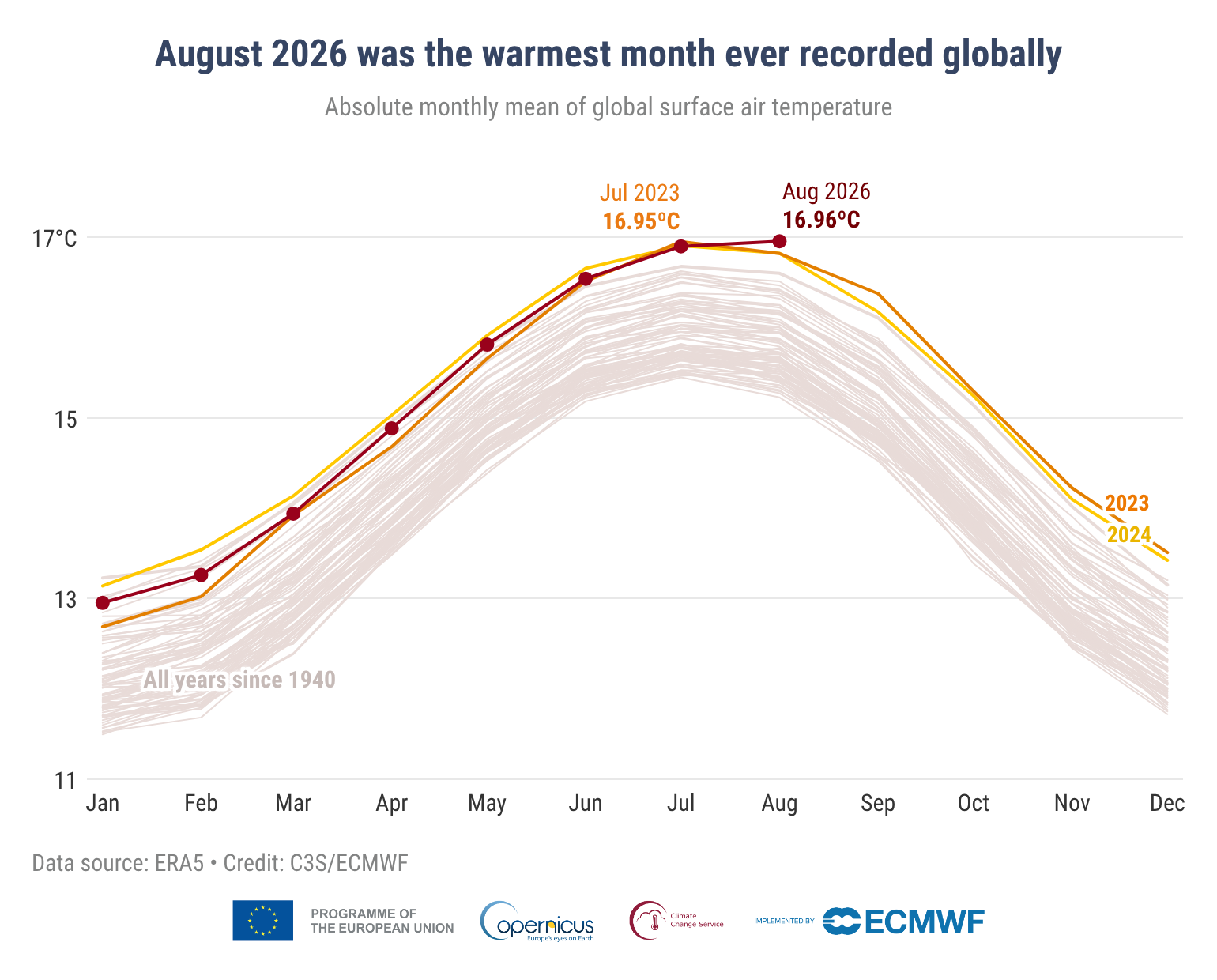
Copernicus reports that August 2026 tied July 2023 as the hottest month on record, at 1.65°C above pre-industrial levels. A single month is not the multidecadal average the report uses to define exceedance, but it shows what the overshoot world looks like. The report ties every extra fraction of a degree and extra year above 1.5°C to higher risk of irreversible change, which is one reason physical risk deserves a larger weight in portfolio analysis. A world peaking near 1.8°C and one heading for 2.8°C by 2100 are very different environments for assets, insurance, agriculture and infrastructure.
What follows from overshoot being a given is a short list of changes to how a portfolio is tested. The no-overshoot 1.5°C case belongs in the optimistic tail rather than at the centre of a scenario set, and the working set should carry the lowest overshoot pathway and the current-policies path side by side, since the 16 to 22 GtCO2e spread in the 2035 gap is a fair measure of how much uncertainty a strategy has to survive. Milestones such as the COP31 electrification proposal deserve a place in demand forecasts alongside temperature goals, and any claim that depends on removal at scale should be tested against the obstacles the report flags before it is treated as a plan.
Overshoot is now a given, but its height, its duration and the credibility of the path back are not, and those remain decisions for this decade.
Source: UNEP, Emissions Gap Report 2026: The point of return.