Big EU companies put EUR 512 billion into green and transition projects last year. Most of it went into power plants and grids.
That figure comes from the EU Platform on Sustainable Finance, an expert group that advises the European Commission. Its second report on capital flows, published in October, counts EUR 330 billion of corporate investment in 2025 that met the EU Taxonomy's green criteria. It adds another EUR 182 billion from companies whose transition plans the Platform considers credible. Together that is 21% of everything large EU firms invested.
That is a fifth of corporate investment, and the report treats it as a starting point. The money is crowded into a handful of sectors and a handful of countries, and the demand side has not kept pace with supply. The factories, buildings and vehicles meant to run on clean power are arriving more slowly than the grids built to feed them.
Mostly power and grids
Taxonomy-aligned spending grew 5% in 2025 and has now passed EUR 1.2 trillion since 2022. Electricity supply took 46% of last year's total, manufacturing 25% and transport services 18%. Generating, transmitting and distributing power accounted for close to half on its own.
Transport services grew fastest, up 23%. Manufacturing managed 4%, and nearly two-thirds of that sector's figure came from carmakers. Some heavy industry is starting to appear in the data. Cement producers reported aligned investment for the first time, if from a tiny base. Chemicals have barely moved.
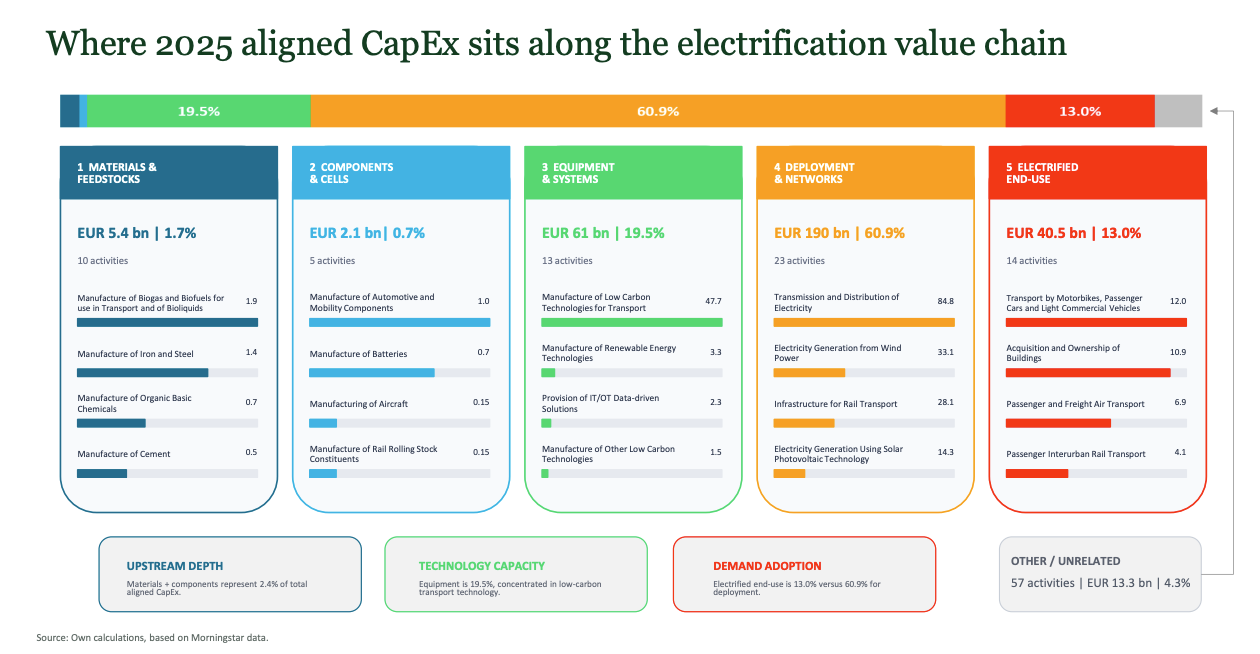
The Platform also sorted the spending by stage of electrification, from raw materials through to the cars and buildings that use the power. Around 61% sat in what it calls deployment and networks: wind and solar farms, power lines, rail. Electrified end uses got 13%. Materials and components, batteries and solar cells among them, got 2.4% between them.
Energy statistics point the same way. Renewables produced 49.9% of the EU's electricity in 2025, but electricity is still only about 23% of the energy Europeans use. Oil and gas cover most of the rest.
By country, Germany accounts for 31% of aligned investment, France 18%, Italy 12%, Spain 9% and the Netherlands 7%. Add Denmark and those six make up 81%. Measured against the size of each economy, Denmark and Czechia come out on top, well above the EU average of 1.7% of GDP, while several member states are at 0.5% or lower. The report points out that the numbers follow where companies have their head office, not where the turbines or rail lines actually go.
None of this closes the funding gap. The ECB reckons the EU needs additional green investment of 2.7 to 3.7% of GDP a year to meet its climate targets. The Paris-based think tank I4CE estimates Europe reached about 61% of the required level in 2025.
Banks, bonds and funds
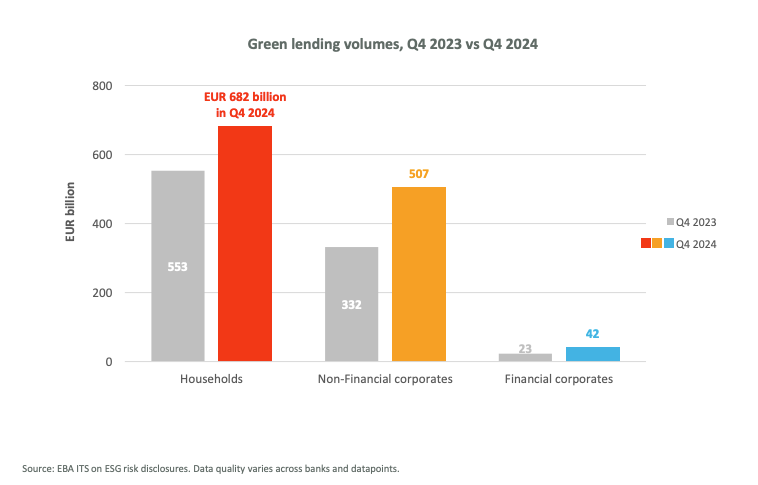
On the financing side, banks are still the biggest channel. Their green lending rose 36% in 2024 to EUR 1.21 trillion, according to their own disclosures. Households received EUR 682 billion, mainly as mortgages on energy-efficient homes, with smaller amounts for heat pumps, solar panels and electric cars. Green loans to companies grew 53% to EUR 507 billion, which the report reads as banks reaching smaller firms that don't issue bonds. Roughly 45% of all green lending, EUR 553.5 billion, meets the Taxonomy criteria.
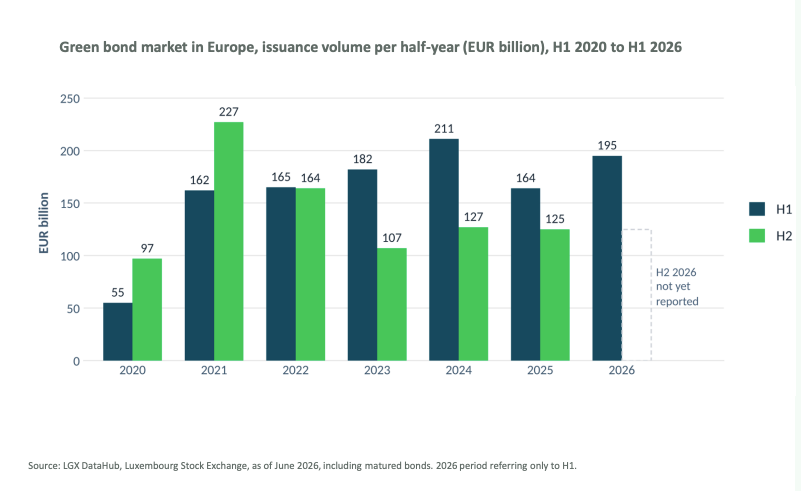
European issuers have sold more than EUR 2.35 trillion of green bonds since 2020, EUR 291 billion of it in 2025. Issuance picked up in the first half of 2026 to EUR 196 billion, almost 19% more than a year earlier. Green buildings received about 30% of the money, ahead of renewables, clean transport and energy efficiency. A green label is no promise of Taxonomy alignment, though. According to issuers' own post-issuance reports, 36% of the activities financed qualified in 2026, up from 1% in 2020.
The European Green Bond Standard, in use since early 2025, is meant to fix that. Bonds issued under it must fund Taxonomy-aligned activities and be checked by reviewers supervised by ESMA, the EU markets regulator. Issuance reached EUR 58.8 billion by late September 2026, and so far every issuer reports putting all of the proceeds into aligned activities. Utilities mostly use it for generation and grids. Banks, starting with ABN Amro, use it to refinance green mortgage books. In the second quarter of 2026 the standard made up 14% of European green bond issuance.
Investment funds are where the numbers stop lining up. Funds registered under Articles 8 and 9 of the EU's SFDR disclosure rules held EUR 9.6 trillion by mid-2026. Article 8 funds took in EUR 327 billion of net new money in 2025, while EUR 21 billion left the stricter Article 9 funds. On average only 2.3% of Article 8 portfolios and 8.8% of Article 9 portfolios are Taxonomy-aligned. Part of the problem is supply: only about 2,000 companies report Taxonomy data, and most funds invest well beyond that group.
What the Platform recommends
The Platform's view is that Europe has plenty of savings; the trouble is getting them into transition projects across sectors and borders. That is why it leans on the Savings and Investments Union, the EU's effort to knit national capital markets together.
Its first ask is to make the Taxonomy cheaper to work with. It wants machine-readable reporting and a free public tool for checking activities against the criteria, which would help banks, investors and smaller companies alike. It also calls for clear rules on when estimates, including AI-generated ones, can be used without inviting greenwashing.
It also wants the Taxonomy to cover more ground. Nearly everything reported so far relates to climate mitigation. Other environmental goals account for EUR 2.7 billion, mostly because few activities have criteria for them yet.
The review of the SFDR fund rules should be finished, too. A dedicated sustainable fund category would raise demand for European Green Bonds, since funds could count them without running their own alignment checks. A transition category could give companies a reason to improve their plans.
And Europe needs more risk capital. Loans and bonds suit established assets, but scale-ups and first-of-a-kind industrial plants need equity, growth funding, securitisation and public guarantees. The report wants pension funds and insurers to play a bigger part.
Corporate transition plans are improving, at least at the top. The number of companies in the Platform's highest credibility tier went from 128 in 2023 to 203 in 2025. Those firms have delivered 67% of the cuts in direct emissions they targeted, against 34% for companies in the lowest tier. That bottom tier has grown as well, from 217 to 266 companies.
The report is upfront about one gap in its own data. It tracks green investment but not the other 79% of corporate capital spending, including what still goes into fossil-fuel assets. The Platform suggests adding companies' fossil-fuel CapEx disclosures to future editions, to show where carbon lock-in may be building up.
Sources
- Monitoring of Capital Flows to Sustainable Investments, EU Platform on Sustainable Finance, October 2026